The official line in July 1952 was that flying saucers were a Cold War distraction — kite-string sightings, weather balloons, Venus low on the horizon. Then, on two consecutive Saturday nights (the 19th and the 26th), radar operators at Washington National and Andrews Air Force Base painted a cluster of unknown targets crossing the restricted airspace over the White House, the Capitol, and the Pentagon. The targets were tracked simultaneously on two independent radar sets, observed visually by airline pilots in flight, and chased — unsuccessfully — by Air Force interceptors scrambled from Newcastle, Delaware.
The press conference that followed, hosted by Major General John Samford on July 29, 1952, was the largest the Pentagon had convened since the end of the Second World War. The official story was “temperature inversion.” The unofficial story is in the file.
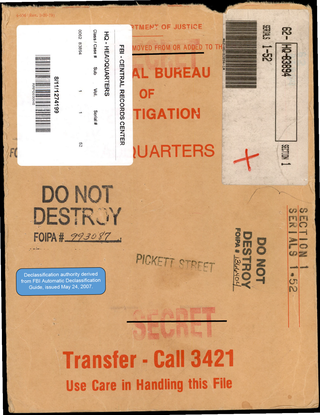
That file did not start in 1952. The Federal Bureau of Investigation had been receiving — and, for a time, actively investigating — flying-disc reports since the summer of 1947, when the Army Air Forces formally requested Hoover’s assistance.
By the autumn of 1947 the Bureau had pulled back — Hoover’s marginalia complains that Army interest had cooled the moment civilian witnesses became hostile — but the paper trail did not stop. The Army’s own catalog, kept at the Pentagon under file designation 319.1, ran continuously from 1947 through the Project Blue Book sunset in 1969.
What is striking about the 1952 flap is how unremarkable the underlying incident pattern was by then. Air Technical Intelligence Center — the unit at Wright-Patterson that had absorbed Project Sign, Project Grudge, and the early Blue Book caseload — was already sitting on close to two thousand incident summaries by the time the Washington targets appeared on radar.
The summaries are terse — date, location, witness, sensor, evaluation — and the evaluations themselves trend toward “insufficient data” rather than “explained.” A reader expecting the file to vindicate either the skeptics or the believers will find it does neither: the cases are catalogued, not adjudicated.
What the 1952 press conference accomplished was less a closing of the question than a re-routing of it. After Samford, the public-facing posture was that the Air Force had the matter well in hand. The internal posture, audible in the AAF correspondence of the previous five years, was that the matter had never been fully in anyone’s hands at all.
Blue Book would limp on for another seventeen years before its formal dissolution in December 1969 under the Condon Report’s “no further study warranted” finding. By then the Washington flap was a museum piece. The file remained open.