On 14 November 2004 the USS Princeton, an Aegis-equipped Ticonderoga-class cruiser screening the carrier Nimitz, began tracking something the radar watch had not seen before. The contacts — multiple, simultaneous, descending from above 60,000 feet to sea level in under a second — were dismissed as software ghosts on the first day. They were not ghosts. They returned the next day. They returned the day after that. On 14 November the Princeton finally vectored two F/A-18F Super Hornets, callsign FAST EAGLE 100 and 101, to intercept.
What Commander David Fravor and Lieutenant Commander Alex Dietrich saw at the intercept point — an oblong, white, smooth-skinned object, “like a Tic Tac,” holding station over a churning patch of ocean — is the part of the encounter that became famous. The part that mattered to the Princeton’s combat information center was that the object did not show up on their FLIR until the pilots painted it from inside ten miles, did not generate a wake or an exhaust plume, and accelerated in a manner that no available platform could match.
The Department of Defense did not release the Nimitz radar logs to the public until 2017, when the journalist Leslie Kean and the former Pentagon official Luis Elizondo brought them to The New York Times. What is now in the open record are the Hornet gun-camera videos, the Princeton’s SPY-1 timeline, and — slowly, file by file — the Department of War’s later mission reports describing incidents structurally identical to the 2004 case.
The Department of War’s range-fouler vocabulary is bureaucratic shorthand for an unidentified object that has interrupted a live training or operational range. The taxonomy did not exist in 2004. The reporting form did not exist. The 2004 Nimitz incident was, in a real sense, written up the way a UFO incident from 1952 would have been written up — by hand, in narrative, with the pilot’s recollections at the center.
By 2020 that had changed. The Arabian Gulf mission reports show the new format: timestamps, sensor signatures, weather state, ROE notes, and a clear chain of who saw what on which screen.
Read in sequence, the 2020 mission reports describe behaviors the Princeton watch team would have recognized: instantaneous accelerations, hover-to-Mach transitions, and a stubborn refusal of the object to register on the platforms an F/A-18 carries. The reports also describe what is new — the routine: pilots filing the paperwork the way they would for a near-miss with a civilian airliner.
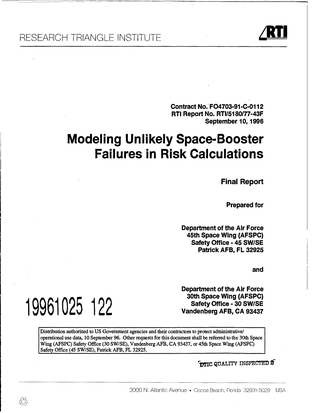
The contrast with the 1990s is instructive. The Air Force’s last comprehensive internal review of UAP-style incident reporting before the modern era is the 1996 document below — and the gap between its taxonomy and the 2020 forms is the gap between the Nimitz incident as a one-off and Nimitz-class incidents as a continuing intelligence problem.
What the Princeton’s tapes are still doing — quietly, twenty-two years on — is providing the baseline against which every later mission report is read.